Your calendar and tasks
The Calendar page is your single view of every partner meeting and every follow-up you owe someone. Meetings come from your connected calendar, tasks come from anywhere in the app where one was created, and both render together so you can plan a week without flipping between screens. Times shown are Eastern.
Browse your calendar
Where to find it: Sidebar → Meetings → Calendar.
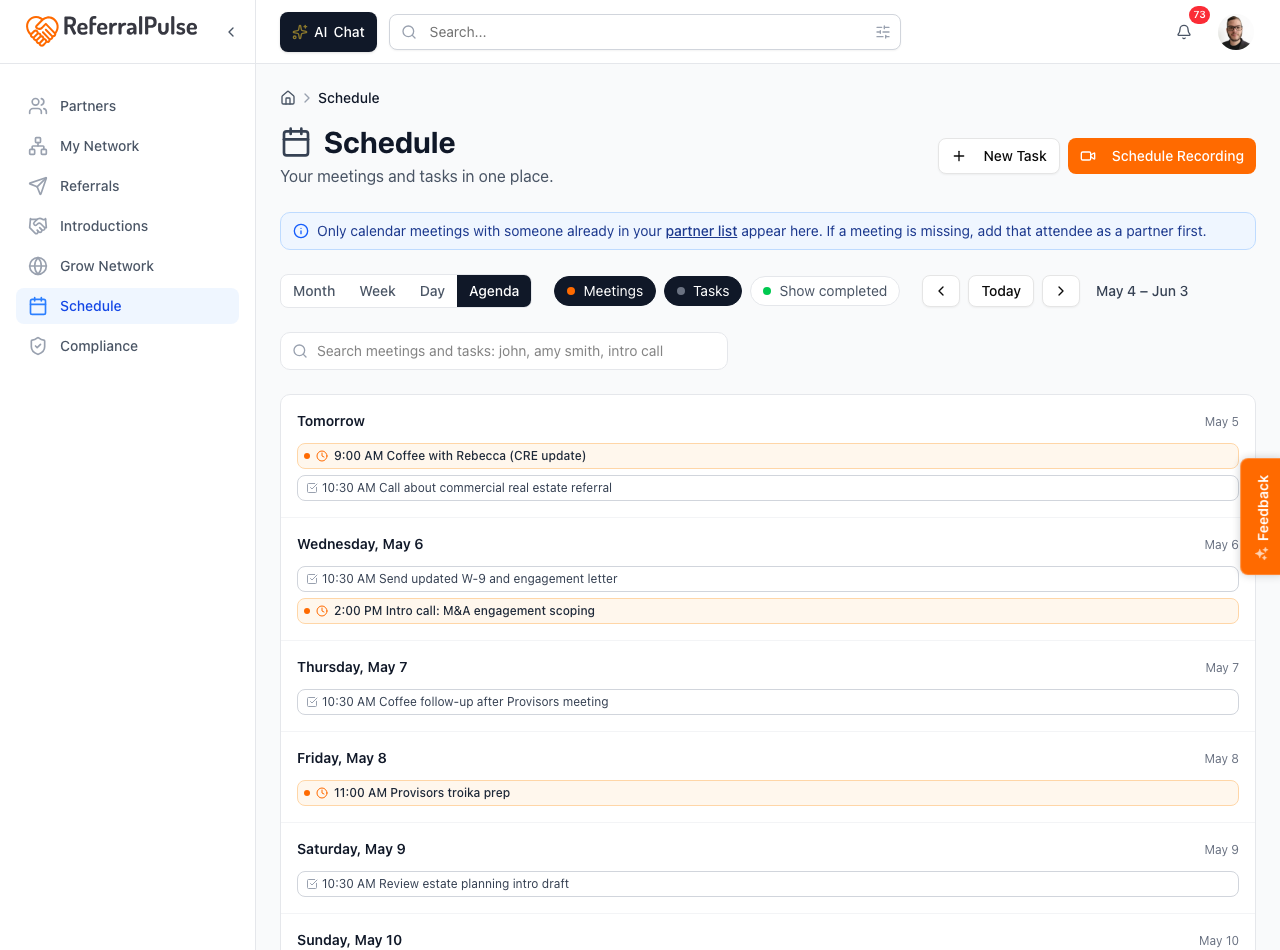
The page opens in Week view on desktop and Agenda view on a phone. The controls row gives you the view switcher (Month, Week, Day, Agenda), the date navigator with a Today button and the range it lands on, and three filter chips with live counts: Meetings, Tasks and Show done.
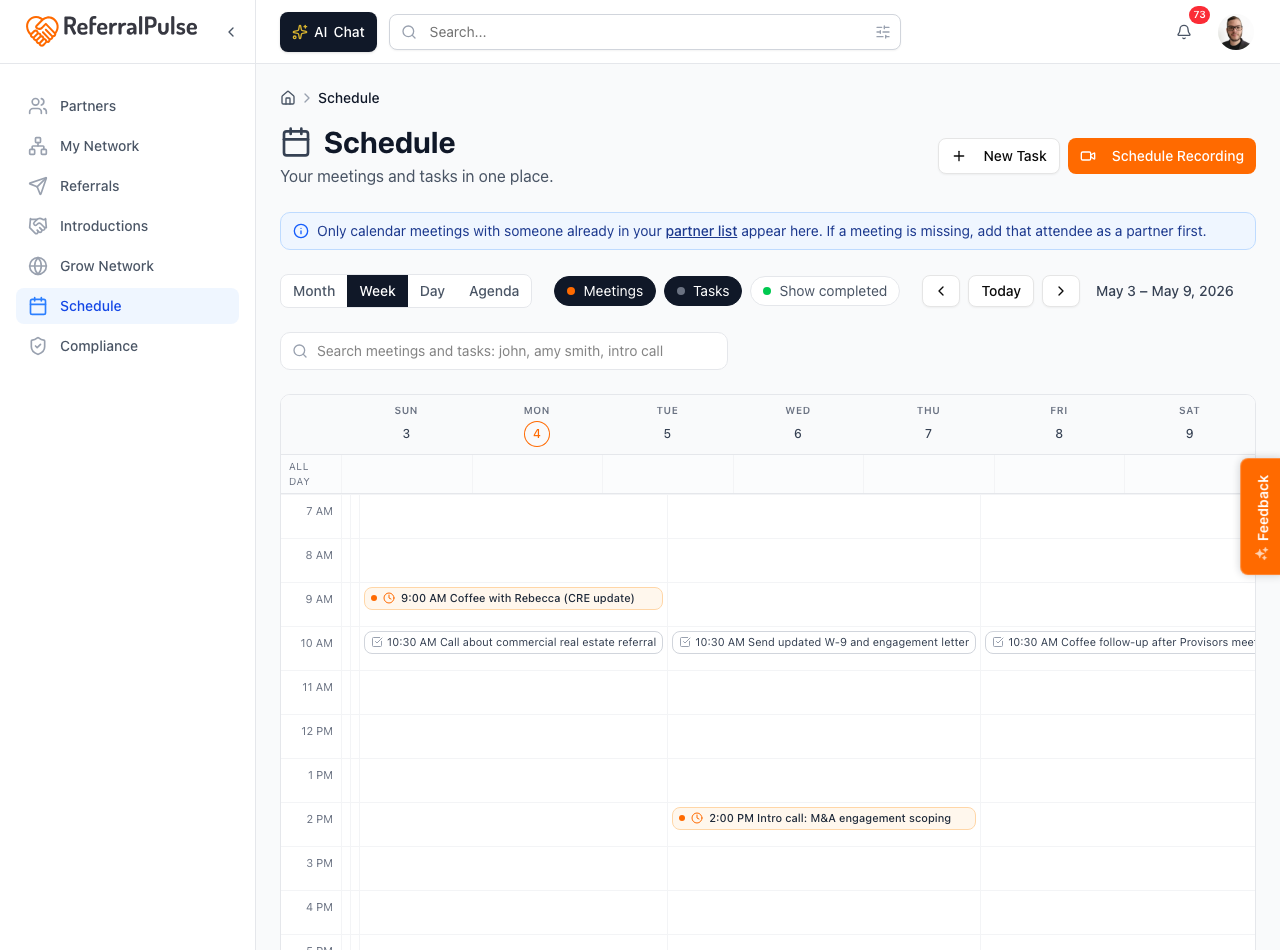
The four views are:
- Month. A grid of the whole month. Click a day to drill into it.
- Week. Seven columns for the current week. Best for planning the week ahead.
- Day. A single-day timeline. Best for the morning view.
- Agenda. A scrollable chronological list. Best on a phone, and best when you just want to know what is next.
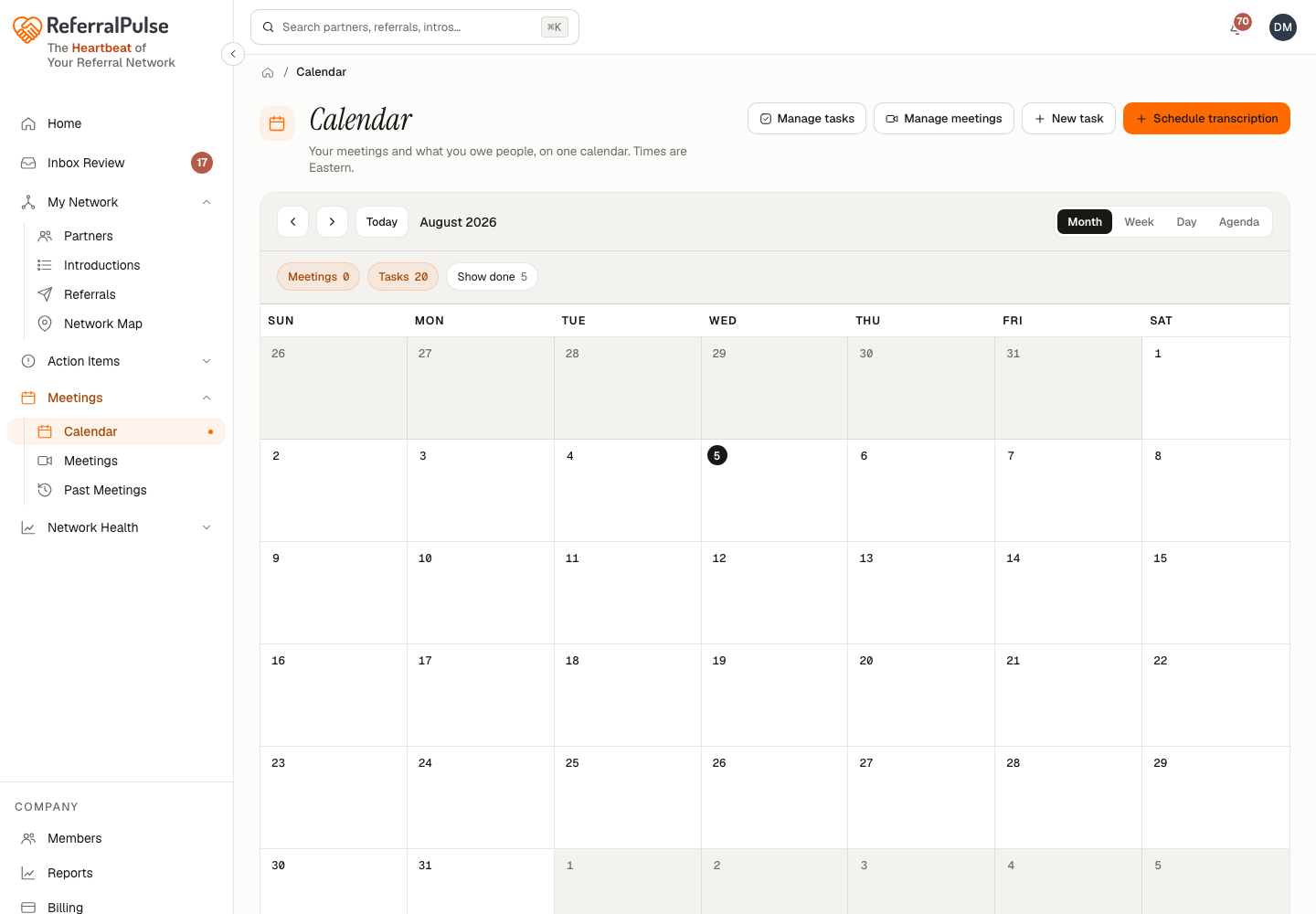
Two links at the top of the page leave the calendar for the full screens behind it: Manage tasks opens your task list, and Manage meetings opens the meetings page. The filter chips are different: they only hide and show things on the calendar itself.
Only calendar meetings with someone already in your partner list show up here. If a meeting is missing, the most likely reason is that the other attendee is not a partner yet. Add the partner, then reload.
Create a task
Where to find it: Sidebar → Meetings → Calendar → New task (top right). Also reachable from any partner page, any referral page, and from the follow-ups pulled out of a meeting recording.
Tasks are how you track what you owe people. Each one can be linked to a partner, a referral or a meeting, so completing it flows the activity back to the right relationship. The form asks for a title, an optional description, a priority, an optional due date, and the partner, referral or meeting to link it to.
Tasks created from the follow-ups in a recorded meeting arrive already linked to that meeting and that partner. Open the meeting, turn an action item into a task, and it lands on your calendar with the link in place. No retyping.
Schedule a meeting transcription
Where to find it: Sidebar → Meetings → Calendar → Schedule transcription (top right).
For a meeting that is not on your calendar yet, like an ad-hoc video call you set up over text, use Schedule transcription. Give it the meeting link, the start time and the partner on the call, and your notetaker will join. See Meeting recordings and notes for the full walkthrough.
Work through your tasks
Where to find it: Sidebar → Action Items → Alerts & Tasks → the Tasks chip. The Manage tasks link on the Calendar goes to the same place.
Tasks live in the same queue as your assistant's drafted emails and your account alerts, so there is one list to clear rather than three. The Tasks chip narrows it to your own to-dos, with All, Open and Completed underneath. Group by Urgency to see what is overdue, due today, due this week or later.
The Calendar is better for planning, Alerts & Tasks is better for clearing. If you catch yourself in calendar view squinting at a task list, switch. If you catch yourself in the queue trying to work out where something fits in your week, switch back.
By voice or in chat
Where to find it: The search box at the top of any page, or press ⌘K. On iOS, the Chat tab in the bottom navigation.
Your assistant can create and look up tasks, and can answer questions about what was said in your recorded meetings.
Add a task to call Robert Ashford about the M&A engagement on Friday.
What's on my plate this week?
Mark the call-Sarah task as done.
What meetings do I have today?
What did Demetrio say about his law clients in our meeting yesterday?
In my call with Sarah last week, what was her idea about the tax strategy?
Answers come from your task list, your calendar and your meeting recordings, without you opening the page. Tasks get linked to the partner or referral you mention.
When you ask about a specific recorded meeting, your assistant reads the whole transcript to answer. Questions like "what did we decide about pricing?" or "what was Tom's concern about the timeline?" get answered from what was actually said.
Get more out of your assistant
Your calendar and your task list are how your assistant sees what is already on your plate.
- Connect your calendar. Without it the meetings half of the page is empty and your assistant cannot see what is coming. Read-only access is enough.
- Add the other attendee as a partner. Meetings only appear here when the other person is in your partner list. If you keep meeting someone the app does not know, add them so the meeting threads back into the right relationship.
- Link tasks to the right partner or referral. Created from inside a partner or a referral, the link is automatic. Created from the Calendar, set it in the form so the activity flows back.
- Record your meetings. With a transcript, your assistant can answer specific questions about what was discussed. Without one, it only knows the meeting happened.
On the iOS app
Where to find it: Bottom navigation → Schedule tab, or through the briefing's upcoming meetings.
The mobile calendar defaults to Agenda, which is the cleanest on a phone. Filters and search work the same, and a plus button adds a task. Voice is the natural way on the go:
Remind me to call Tom Friday morning about the Pham referral.
Your assistant adds the task with the partner and the referral both linked, sets the priority and confirms once saved. You can also ask about past meetings:
What did Sarah say about the estate plan in our meeting last Tuesday?
Agenda is the same view that feeds the upcoming meetings card on your home page. If something looks wrong there, opening Agenda usually shows you why faster than scrolling the calendar.