Every email is a draft until you approve it
ReferralPulse will never send an email to a partner, a referred client, or anyone else in your network without you reading it first. Every partner-facing email your assistant produces, thank-yous, status updates, introductions, follow-up nudges, referral notifications, opens as a draft you can read, edit, send, save for later, or throw away. You always have the last word, and it will never read like a generic template.
This is a deliberate design choice. The relationship in your network is yours, your name is on every message, and a tone-deaf email costs more than a missed one. So the assistant writes, but you sign.
Where drafts show up
You will see drafts in five places. Each one looks slightly different, but the rule is the same in every one: nothing leaves your account until you click send.
By default, the emails you send Cc your own address so you keep a copy in your inbox. If you've connected a mailbox (Gmail or Outlook), that Cc-to-self is left off, since the message already lands in your provider's Sent folder. You can add or remove recipients on any draft before sending.
After you log a referral you sent
When you save a new referral on the Send Referral form and the partner has an email on file, a dialog opens with a draft notifying the partner about the client. The dialog title is Introduce [Client] and [Partner]? when the client also has an email on file, or Notify [Partner] about the referral? when they don't.
The draft is pre-filled with a subject and body the assistant has written from the referral details. Both fields are fully editable. At the top of the dialog you'll see the recipients listed (To and Cc) so you know exactly who the email goes to.
Two buttons at the bottom: Send email to send it as written, or Skip to close the dialog and not send anything. If you skip, the draft is not saved anywhere. The referral is logged either way.
If the client has an email on file, you'll see a segmented choice at the top of the draft: Introduce [Client] and [Partner] for a two-way intro that loops the client in, or Heads up to [Partner] for a one-way notification. Picking a different option rewrites the draft to match.
After you log a referral you received
When you save a referral on the Receive Referral form, the assistant queues a thank-you draft to the partner who sent it. The draft opens in an editor with the dialog title set to the action it represents, like Thank Mary for the Henderson referral.
You can edit the subject and body, click Save Draft to keep your edits without sending, Later to dismiss the dialog and leave the draft in your Alerts & Tasks queue, or Send Email to send it. If you click Later, the draft sits in the queue until you come back.
From Alerts & Tasks
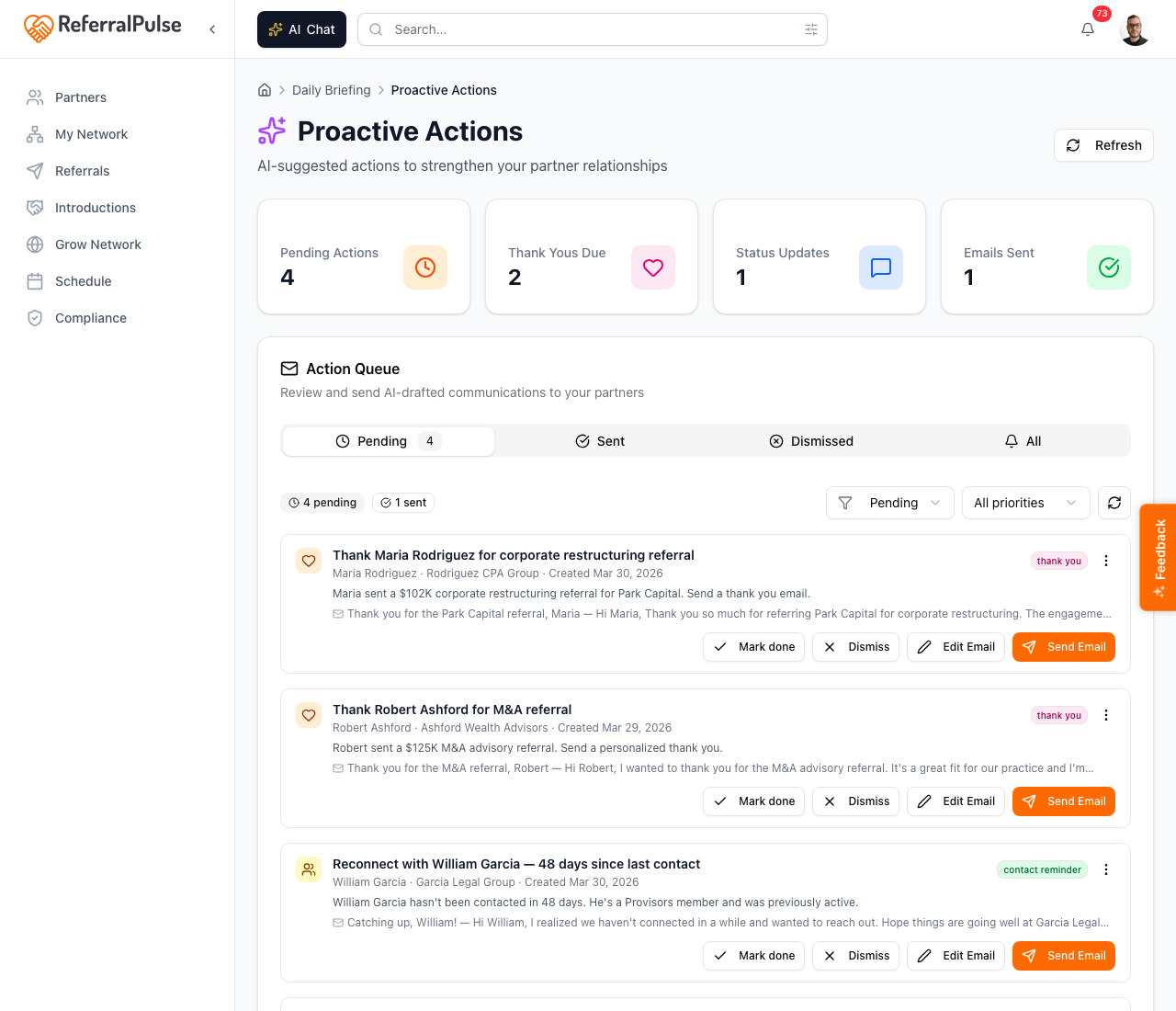
Alerts & Tasks is the catch-all for drafts your assistant builds in the background, the ones it surfaces because it noticed something worth your attention. Examples:
- A partner you give referrals to but rarely hear back from, with a draft asking how things are going.
- A referral that's been sitting open for a long time, with a draft to the partner asking for a status update.
- A meeting that just wrapped, with a draft thanking the partner and recapping next steps.
- A partner whose birthday is this week, with a short personal note.
Where to find it: Sidebar → Action Items → Alerts & Tasks, then the Actions chip. You can also get there from the bell icon in the header. Drafts sit in the Queue card, and the chips under the card header narrow them to Pending, Sent, Snoozed or Dismissed. Review & send on any row opens the same draft editor, with Save Draft, Later, Send Email and Regenerate, plus the Tell your assistant what to change line at the bottom of the message itself.
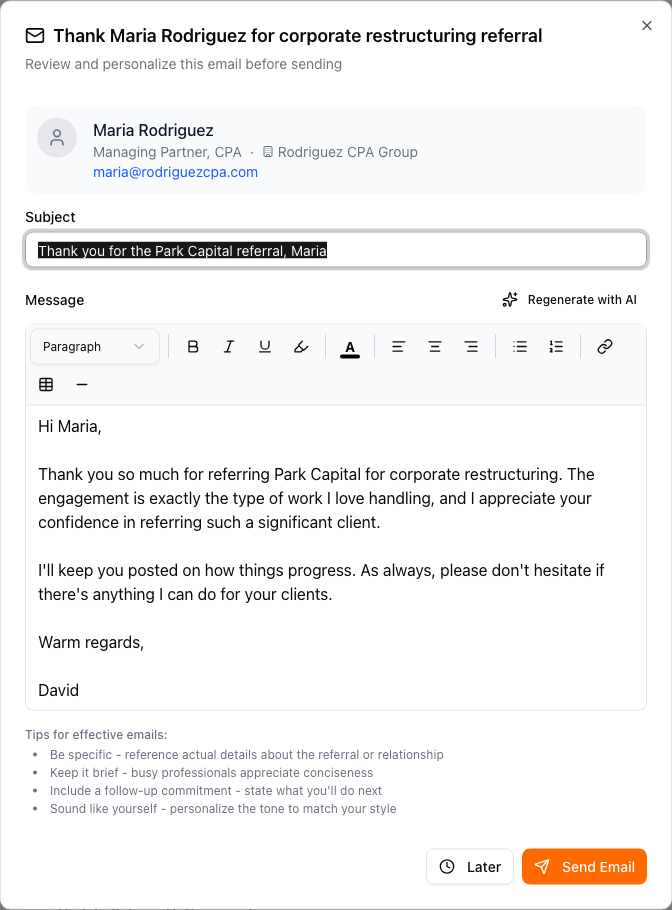
The queue is the only surface where drafts persist for as long as you want them to. Later snoozes the card so it stays in the list. Save Draft captures any edits you've made so the next time you open the card your version, not a fresh draft, is what you see. Drafts in the queue do not expire.
Telling your assistant what to change
At the bottom of the message itself, inside the same box as the text, there's a line reading Tell [your assistant] what to change, using whatever name you've given your assistant. Type what you want different, press Enter, and the draft updates in place: "shorter, and mention the Denver project", "warmer", "drop the last line", "say I'll call her Tuesday instead". Click into the line and three suggestions appear for the common ones: Shorter, Warmer, and Add a detail from our meeting on a draft that came out of a recorded call.
The important part is that it edits the message that is in front of you, so any wording you typed yourself is still there afterwards. It reads the draft as it stands, applies what you asked, and leaves the rest alone.
Regenerate, up beside the Message label, is the other thing entirely: it throws the current draft away and writes the email again from scratch with the latest context about that partner, so anything you had typed goes with it. Use Regenerate when the whole draft is wrong or the situation has changed, and the input when the draft is close.
You can do the same thing by asking: "make the note to Sandra shorter" in chat revises that card's draft and hands it back for you to read and send.
Inside the introduction composer
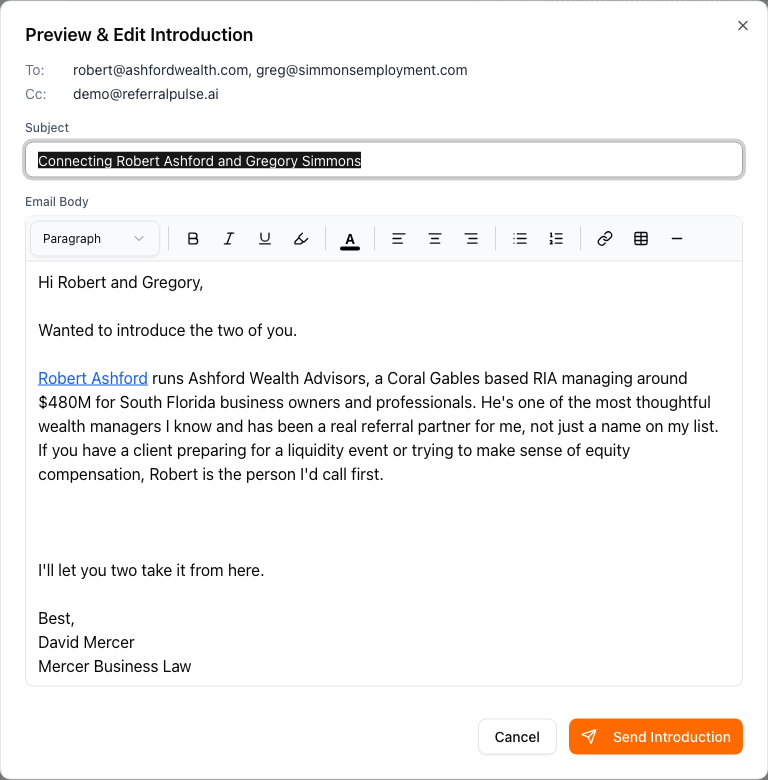
When you build an introduction between two partners (Introductions in the sidebar → Compose), you'll see a Preview Email button once both people are picked. Clicking it opens the Preview & Edit Introduction editor: the full email with both partners' intro paragraphs, the To line, and your Cc.
The intro composer is a one-shot draft, not a persistent one. Send Introduction sends it. Cancel closes the modal and the draft is lost. There is no save-for-later in this flow because introductions are typically composed in the same minute they're sent.
From your voice or chat assistant
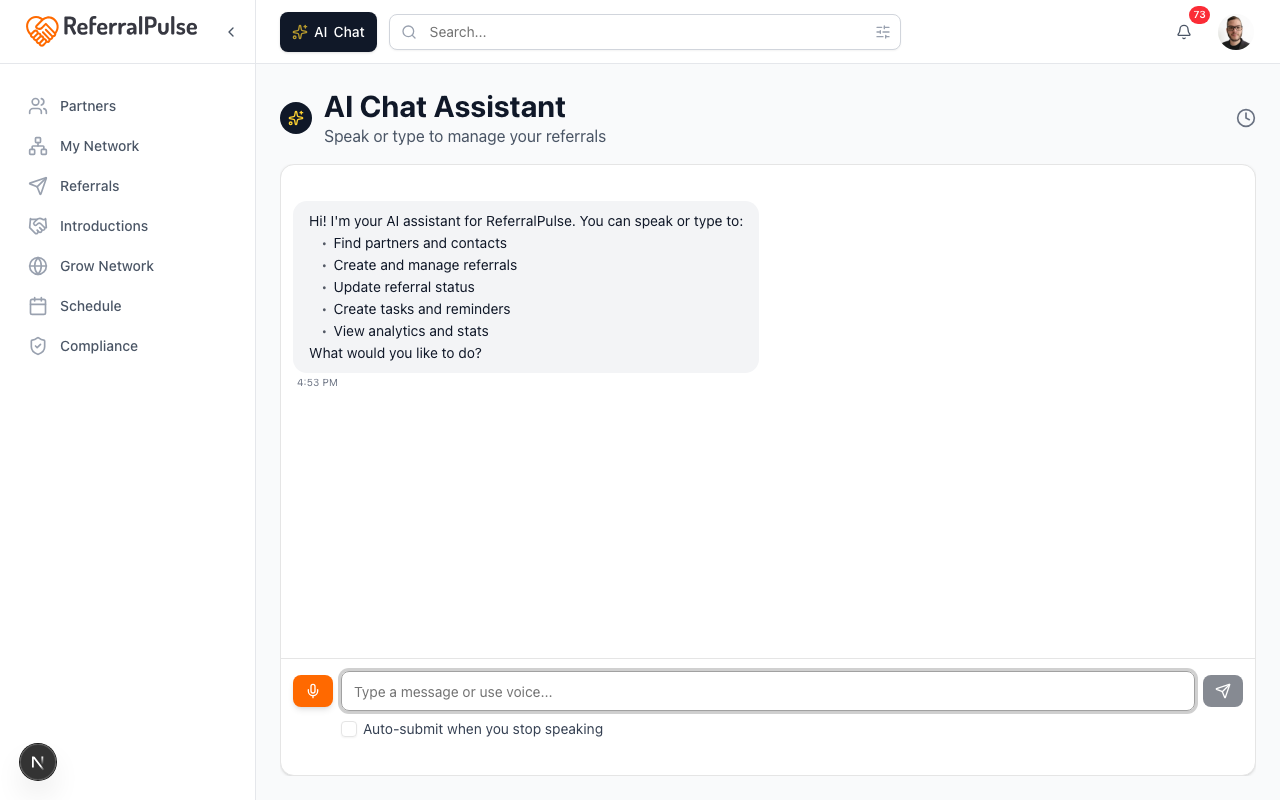
When you ask your assistant to send an email, by voice on iOS or by typing in the AI Chat panel, it doesn't send. It drafts, and the draft appears as a card right inside the chat. You'll see the subject, the body, the recipient, and three buttons: Edit, Cancel, Send.
Edit lets you tweak the subject or body. Cancel closes the card and discards the draft. Send actually sends.
If you ask "send Sarah a quick note thanking her for the Watts intro," the assistant writes the note, shows it to you in a card, and waits for you to click Send. It will not send on its own, even if you tell it to "send it for me." Sending requires your explicit click on the button.
You can also change a draft that is already waiting in Alerts & Tasks without opening it: "make the thank-you for Maria shorter" or "warmer, and mention the Denver project" revises that card's draft and brings it back for you to read and send.
What you can do with a draft
The buttons differ slightly across surfaces, but the available actions in each surface use these labels:
- Send Email or Send Introduction. Sends the draft as you've written it. The email leaves your account immediately. Replies come back to your inbox.
- Save Draft. Captures your edits without sending. Available on Alerts & Tasks cards. The next time you open the same card, your saved version is what you see.
- Later. Closes the editor and leaves the draft in Alerts & Tasks. Available on Alerts & Tasks cards.
- Tell your assistant what to change. Edits the draft in front of you the way you describe, keeping the wording you kept. Available on Alerts & Tasks cards, on the web and on your phone.
- Regenerate. Rewrites the body from scratch with fresh context, discarding your edits. Available on Alerts & Tasks cards.
- Edit / Cancel. On voice and chat draft cards: Edit lets you tweak the text inline, Cancel discards the draft.
- Skip. On the Notify Partner dialog after a given referral: closes the dialog without sending. The referral is still logged.
Whatever you send goes from your name with replies routed to your email address. Partners see the email as coming from you, not from a "noreply" account, and their replies land in your inbox.
Where drafts live (and where they don't)
| Where it came from | Persists if you close it? |
|---|---|
| Alerts & Tasks card (thank-you, follow-up, status nudge) | Yes, stays in the queue until you send or dismiss |
| Notify Partner dialog (after Send Referral) | No, discarded if you skip or close |
| Introduction composer | No, discarded if you cancel |
| Voice or chat draft card | No, discarded if you navigate away |
| Bulk invite personal message | No, discarded if you don't send |
Alerts & Tasks is your draft inbox. Anything you want to come back to later, leave it there with Later or Save Draft. The other surfaces are for in-the-moment drafts you're either sending now or letting go.
If you're not ready to send a referral notification or an introduction right now, save the work into Alerts & Tasks by sending yourself a quick draft about it via the assistant. Voice command: "Remind me to email Sarah about the Watts intro tomorrow." The reminder goes into your queue with a draft you can edit and send when you come back to it.
What about system emails?
A small number of emails ReferralPulse sends are not person-to-person and don't go through the draft step. These are emails the app sends on its own behalf to operate, not on yours:
- The first welcome email when you create your account.
- Connect-your-account invitations to partners you've added (the partner sees a templated email from you with an optional personal note you wrote in advance).
- Password reset and account security emails.
- Onboarding reminders the app sends to nudge you back in.
These never include details about your partners, your referrals, or your relationships. Anything that does, anything where the message is from you to someone in your network, always goes through a draft you approve first.
On the iOS app
Where to find it: Bottom navigation → Chat tab for new drafts; your Alerts & Tasks queue for drafts waiting from earlier.
The voice and chat draft flow on iOS works the same as the web. You ask your assistant for an email, the draft appears as a card in the chat feed, and you tap Edit, Cancel, or Send. Cards are full-width on a phone screen and the body field is scrollable, so even a long thank-you note is easy to read.
Drafts you left in your Alerts & Tasks queue from earlier in the day show up in your Actions feed. Tap any card to open the same editor you'd see on the web, including the Tell [your assistant] what to change line at the bottom of the message, then send or save your edits.
Hands-free drafting is one of the most useful patterns on iOS. After a meeting in the car, dictate "thank Marcus for the Pham referral, mention I'll get back to him by Friday" and the assistant has the draft ready in your queue when you open the app at the next stop. Read it, edit if you need to, send.